








Shaping eCommerce with Pete Kelich, HubSpot Principal Partner Account Manager
In our interview with Pete, we discuss who coined the term “inbound marketing,” how B2C companies can benefit from Hubspot, and where Hubspot is headed.
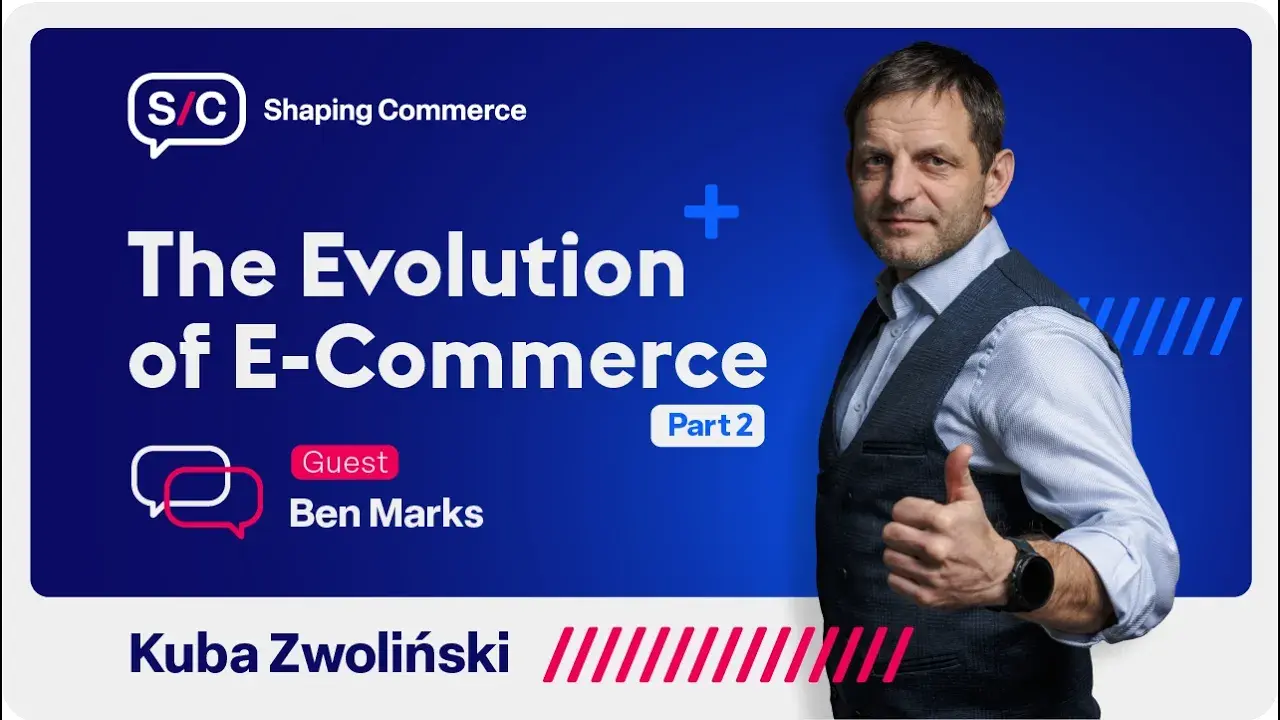
Full transcript of YouTube episode of Shaping Commerce -- Part 2 of our conversation with Ben Marks, Global Community Director at the Magento Association. Are niche platforms the future of the mid-market? In this episode, we move beyond the 'giants' to look at the broader ecosystem. We dive into the rise of Shopware, the developer-centric approach of Sylius, and the marketplace potential of Medusa. Ben also breaks down the "VUCA" model and explains why community is the ultimate hedge against market volatility. We wrap up with Ben’s new mission with comVisory.com and his vision for a resilient, global developer community.
Premiered June 9, 2026 IronPlane eCommerce Development
Kuba Zwoliński: Something I saw at Meet Magento Poland this year was that there is a really growing number of merchants who have their own in-house development teams. This is something that we already talked about – that working with open source is way cheaper because of the whole situation in the IT market. There are a lot of good specialists who are available for work for, I would say, half of the money that it used to be. So it opens a lot of new possibilities. And, of course, Magento is way more mature. So that's like – it's still a complex platform but definitely way more stable than it used to be a few years ago.
Ben Marks: Yeah. Yeah. Yeah. How was the vibe from Meet Magento Poland looked really good.
Kuba Zwoliński: Yeah. Like it reminded me of the early editions and I think it was mostly because I really made it very clear that it is a techie event and I invited – like, it was a very clear message. We invite people who work with this technology and who want to learn more. We will not have like the typical business case studies. When we cover some topic, we want to talk more about technology.
So only one stage, no business and technology, just a stage about technology and processes, and that was great. We had a full room all day – it was amazing. But in the same time we had 250 people and I think this is the right number for Poland and even gathering some people from outside of Poland. This is just the right number because Magento has its space. If it's like slowly growing or staying the same, this is the right number of specialists for Poland. We will not gather like 600 or 700 people. It doesn't make sense. But for 250, it's just perfect. There's a great opportunity for networking, for learning, for workshops, for anything. So this – I usually try to be, you know, more distanced. I'm an organizer, so I shouldn't be, you know, like so proud of my own event, but this time I think it was like the perfect balance.
So I like it and I want to do it this way because I see the future of Meet Magento just like that – like a more relaxed but highly professional event – a place where developers from agencies and developers from in-house teams can meet and exchange knowledge because those people who work with one project for years – they need also some space to learn something new from different stores. So anyway, it was good and I hope that you will visit next year.
Ben Marks: Yeah.
Kuba Zwoliński: I started building a budget because I definitely need real benchmarks – not like the cardboard one [laughter]. I still have it. If I had an idea, I will put it behind me at some point – but I know that's crazy, I don’t want to do that [laughter]!
Ben Marks: As I've interviewed with different companies in the last year – and my god I feel sorry for anyone who's in the freaking job market – it's been brutal. But it's, you know, you start to – I have to sort of describe sort of the things that like – cuz I'm not one to brag about myself – it's against my nature, but it's sort of like, “Well, how do – I have to talk about the realities of things that happened.” Yeah, there were t-shirts and stickers and there is a cardboard cut out of me somewhere like life-size full in Poland.
Kuba Zwoliński: But this is like, the idea has a new version – I don't know if you saw the Colliber team – they have even more cardboard Collibers there.
Ben Marks: Oh my gosh!
Kuba Zwoliński: There is only one band but there are way more orange people there.
Ben Marks: Oh wow! I remember there was the – what was it – Slava – he came to me once and he showed me there was a bobblehead. There was actually a Ben Marks bobblehead and I think I just said like “No. Just please no no no no just let's not do that.”
Kuba Zwoliński: Yeah! At some point – it was like, you know, you open your fridge – oh, Ben Marks is there. So – actually we skipped that part that we – we haven't introduced you and at some point at the beginning….
Ben Marks: You're gonna have to slice this in somehow. Yeah. Okay. By the way, I'm Ben Marks.
Kuba Zwoliński: Yeah, you are that “Dead Ben Marks.” I actually found your first – one of the first posts on Reddit 12 years ago and your nickname was that – Dead Ben Marks – and it was – your words were the best because you are a true legend of that word – that longtime Magento developer, educator, and community member and finally hired by eBay to be the official Magento evangelist. And for me, you and Sherrie – you are the founders of the community. Like, you know, Roy and Yoav may be founders of Magento, but you are founders – both of you are founders of the community.
Ben Marks: Yeah, Sherrie is fully capable of speaking for herself. I was always happy to – gosh, working with Sherrie was the best because, you know, we've all worked together. I've said this more than once about Sherrie. Many of the meetings I was in with Sherrie were fundamentally different because Sherrie was there, right? Because of her contemplative nature and because of how she saw things and the analysis and initiatives that she would bring into the meetings were always just genius. I will try – I will guess what she might say in response to that because I think we would share the same response, which is that we were brought in to manage something that existed and we both – whenever we said “manager” we were always tongue-in-cheek because there's really no managing – there's like the interacting with it. Because the cool thing was, because of the way Roy and Yoav intentionally set Magento up and pushed it out and made it open source and let people organize naturally around it, it always had the local flavor.
So the Germans, you know, organized it their way, the Dutch their way. In Poland, we were lucky enough to be just “nerve center” for it, and trusted and empowered to help – you know, the things that the company would say actually work and be close to the people who were actually taking the product and the services, and seeing if it was actually living up to what was being promised. And then we were able to go back and, you know, occasionally we'd say, "Hey, this is – we're deviating from what we're promising” or “This is really important; we don't see this acknowledged here." And the company did a pretty good job, most of the time, of listening to us.
So I think we would say – I don't know that we would use the word “founders” about ourselves, but certainly it was – man, it was a moment in time for me.
Kuba Zwoliński: You know, for me – I came to my first Imagine in LA and I knew no one. I just started working with that. And actually it was Sherrie who tweeted something about it and she was the first person I met in the whole community. So that was something that I will always remember and it somehow shaped how I think about the community – about helping each other here.
But I don't know how much you can and want to talk about Shopware. You spent some time there. For me, looking from the agency perspective because – I will be honest – I was considering Shopware as an alternative and I think that at some point they just made a big mistake trying to be another Magento with the same pros and cons with all the same mistakes just exactly the same instead of building its own path. Is it just my perception or…?
Ben Marks: Well, I'll start with a caveat, which is that my editorial discretion in this area was limited for reasons that can't be confirmed or denied. But I mean, you know, I'm a big fan of you know, I still chat regularly with the US team especially because I think, you know, the US was my baby. I'm the one who got Shopware USA started, got it up and running. I mean obviously the founders and the exact team and the board – you know, they found Jason who runs the US team and you know got everything staffed up by the time I left earlier this year.
I was a known quantity of Shopware for a very long time. I had visited them at their Community Day, kind of their little version of Imagine, back in 2016. I had actually just accidentally sat down next to one of the co-founders, the two brothers founded it. I had no idea and was like, "Hey, what do you do for Shopware?" “I'm the founder.” And the bad thing was, I had studied – like, I'd like to study so I'd know who the key figures are when I'm – especially when I'm going into a new world. And I was like, "Oh, yeah. Yeah, okay. Now I recognize you."
We joined with the goal of ideally getting Shopware up and running in the US. It was way harder, way more time, money, energy than any of us really would have thought, although it turns out basically market entry takes about three years. We've heard this from countless businesses now, just without prompting. But when I first joined, I mean, there was a slide internally that was really focused on killing Magento. I mean, not exactly like that, but I'm like, you know, this seems unnatural. And I remember when we were at a Partner Day just after the Adobe acquisition in the UK, and there was a little bicycle outside of the partner meeting just leaning up against a street post or maybe it was on a stand, and it had like little fairy lights on and it was basically like, “We're always here for you” or some cute little thing. I mean, it was cute, but this was the engagement back then. And it just – I think it showed Shopware has very humble beginnings. I mean, it was just two teenage brothers back in 2000 started a tech services company. One's kind of the designer messaging person, marketing person, and then the other is the tech guy. And then they built an e-commerce store for somebody local, and then more people wanted it, and that was the origin story.
As they became bigger and bigger, and then once investment came in, which was a good step, it allowed them to really take on a true international perspective. And by the time I arrived, and this was 2021, they had already started – they'd converted the company because this is a small town like Nordrhein-Westfalen you know this is – English wasn't as penetrated there, you know, as it was in Poland.
Kuba Zwoliński: Yeah – I’ve never been there, but I’ve heard, yeah.
Ben Marks: It takes forever to get there. Man, it's like you land somewhere, either Frankfurt or Amsterdam, you're still like a solid three-hour train ride and like hour-long taxi or bus ride to the office. But they had already undertaken the work of converting the company to English first. They were taking the steps that they needed to take and it probably would have been better if they had taken those steps earlier, like a few years earlier, but, you know, who knew what was going to unfold.
But by the end of it, you know, I think – look, it's been a long time since I'd heard Magento's name really bantied about when I was at Shopware. I think probably the biggest, you know, and most practical reality there is for the B2B, which I think is, you know, B2B is where something like Shopware shines, certainly something like Magento shines. And I think it's important for Shopware to have feature parity, or close to it, with B2B functionality.
The B2B story there– the reality was when Shopware 6 came out back in like 2019-ish, in order to get it out by that time they basically took the Shopware 5 B2B module and just sort of ported it into Shopware 6. So it was sort of the Shopware 5 idiom of development and approach inside. I mean, anyone that's worked in software products was like, “Oh yeah, yep, you've got to get it out the door, and this is the thing” – that was the fastest path to that release date. I wasn't there at the time, so if someone from Shopware talks about it they'll know more than I do. But that's just been my impression.
And so it was a little bit tough with B2B, because if you were really good at Shopware 6 in general, then when you go into the B2B stuff it's different. And Shopware over the last few years has spent a lot of time and money basically making sure the B2B components written in the Shopware 6 style were more and more plentiful. I I haven't looked at the code at all really this year, so I don't know what their progress is like. But last I remember, it was a huge priority and I think it's the right priority for them.
But again, the main point is, it's really good that I Shopware very quickly – shortly after I joined – really had its own sense of identity, you know, completely independent of Magento, right? Because it's its own thing and I think, for the record, Shopware did something really smart which was kind of wait for Magento 2 to come out and see what that was like because they built Shopware 6 from scratch and they didn't make a lot of the dumb decisions that we made at Magento, namely, trying to make every single thing at every single layer of dependency injectable. Because you don't need – there's really hardly any time that you need to change how routing works or, you know, just these core framework level concerns. It doesn't matter. And you know what they based it on – Symphony. Symphony has a great eventing framework. We'll just use Symphonies and we'll just kind of bubble it up to the top. So there's just a lot less complexity in there. And that was a good lesson that we learned as we – as I started talking to agencies that did both Shopware and Magento – that agencies would tell us (and these were not just agencies trying to make us happy) – agencies would tell us like matter of fact it's generally faster to build something in Shopware and our developers learn Shopware more quickly than they learn Magento, right? That was just the reality.
Kuba Zwoliński: But it's interesting that it looks like the estimations in general – at some point they equalized.
Ben Marks: Really?
Kuba Zwoliński: Yeah, like when I'm looking at different offerings for – even, you know, when we are competing with someone for a project – Shopware is not that much faster and cheaper anymore. So maybe it's just something changed.
But anyway, I think it looks like it's going a little bit the OroCommerce way? They’re finding, you know, the B2B sector as a….
Ben Marks: Well, I mean, Oro was always B2B, folks. I keep in touch with my buddy over there, Aaron Sheehan – fantastic person, has the bright analytical mind. And they were – the play there was always for B2B. I mean, that was why they did Oro CRM – to get the B2B customers. And then, once the unlock was there from Yoav's time after eBay dropped the Suite. And you’ve still got Dima there, they've got Jary Carter back, so they're – yeah, I think it's a really cool application, they've got some really cool customers.
They were very smart to get into payments this year. I was very happy – that was Aaron's project and I was very happy for him to do that. I think every e-commerce platform has to get into payments. I mean, look at where Shopify is today. And really, the only money left – and I think that means actually getting beyond revshare with PSPs – it has to be like, “What are we? What kind of integrated vertical sort of payment delivery option are we?
Kuba Zwoliński: Yeah, that's actually a big question for me – why Adobe is not using Magento Open Source as a tool to use Adobe payments for mass users. That could be like – that's how it all started with PayPal – going to the mass client with Magento.
Ben Marks: Yeah. I mean, that was the whole – the origin story for why eBay even became aware of Magento was, you know, someone at PayPal was looking at like BN codes going like, "Wait, what the hell is this Magento thing?" And then they look under the hood like, "Oh my gosh, this thing that we had no idea about is stuffing tons of TPV through our pipes." Made sense to go out and, you know, go out and acquire it.
But yeah, the problem – well, so it was a matter of distribution, right? But now you have this situation where, like this year I was at PayPal Dev Days earlier this year in San Jose and they were talking about, “Oh yeah, we're going to have catalogs be built into PayPal.” Okay, so they're now increasing their scope and they're – and now with agentic does it even matter if you have an e-commerce site? I mean, obviously it does, at least for the foreseeable future but I think, you know, PayPal, the payment companies are the ones with the real power here and it's still a revshare, as far as I know, it's still a revshare agreement.
I know the dollar value of that agreement that created Magento Payments. It has expanded since then, but it's still – I mean it's not even a drop in the bucket in terms of Adobe's normal revenue. Actually, it's a good chunk of change that would really help Magento be self-sustaining. But they don't really – I think basically anything Magento Open Source is just a damn long tail and the numbers involved in any kind of optimization or tuning relative to what Adobe is getting out of AEM bills – just even looking at digital experience business – that silo of Adobe – yeah, it's not enough money to really be interesting. Again, if you were able to firewall….
Kuba Zwoliński: Small part of merchants – yeah small parts of merchants are actually bringing a way bigger revenue than all of those….
Ben Marks: You know what would make me super happy would be if Adobe said tomorrow, “You know what? We've taken this Magento thing as far as we can. There's still value there, but not enough value for us, and so we're going to give Magento to the Magento Association and we're going to come up with some agreement around, you know, the revshare that's there and figure out licensing and all this other stuff, but we're basically going to turn it over and let it, you know, let the funds that exist there sort of help it continue on its way and we'll go our own way with Adobe Commerce.”
Now again, I would never expect them to do this, certainly – on their own, unprompted – because again, at some point someone on the Board or Shantanu or, you know, immediately below that level has to be the one that says yes I think we can give up this $1.7 billion brand that we bought and I am not sufficiently enough of a business person to understand what that looks like.
Kuba Zwoliński: Of course, we can explain it because they paid, actually, for the commerce component. It's more like a virtual thing to buy a commerce mindset and that was something that was worth the money, not the technology itself.
Ben Marks: Yeah.
Kuba Zwoliński: It was just that Adobe, after acquiring Magento, they could say, “We are the commerce company too, now. We have commerce.” So that was the value that they – so I totally agree.
I think that letting go of Magento and giving its freedom – it would be the best, like – because right now nobody knows how to promote Adobe Commerce or Magento – is it the same or not anymore? I think it is going different ways.
Ben Marks: Absolutely.
Kuba Zwoliński: Like for me, it's back to roots, it's Magento Open Source. Like, you know, Meet Magento is about Magento. It's about open source and I think that's fine. So maybe it will become in some natural way like….
Ben Marks: It's, it's – go ahead. Go ahead.
Kuba Zwoliński: Yeah. Yeah. Like because when we are talking about open source, like I'm a big fan of Polish Sylius. What do you think about it?
Ben Marks: Sylius?
Kuba Zwoliński: They have a very interesting approach. They want to be independent. They want to be like developers-focused and I'm a big fan, but I also – like, I'm worried if this developer-centric approach can really survive in the business world.
Ben Marks: Well, so yeah. So I've been to Sylius Con. I mean, the people there – folks there are great, the community around it's great. A lot of Magento folk in that space as well, and on paper it is great – you know, it's really componentized and very developer-centric.
But like all those years I spent wearing like Magento shirts – especially to not Magento events like PHP or other conferences – I’d get so many people so mad at me that Magento succeeded because like, “Well, I've got – what about this platform over here and da da da, and it's PSR everything, it's perfect, it's brilliant, and it's not bloated.” And I'm like, well because at the end of the day, developers aren't buying this stuff. I mean I'm glad to see that there is, I think, more tech team input into decisions, but it was always like the, you know, marketing or board members like, you know, going out playing golf and then like, “Have you heard of Magento? It's the best thing in the world. We're using it over here.” Great.
And then they come back like, “Guess what? We're going to use Magento.” And everyone – the whole tech team – this literally happened in one of my classes – the tech team had been in the company for like over 17 years, right, at this big, big US brand. And they were a Java, entirely. They were all Java. But no – someone from marketing was like, "No, we're gonna use Magento." So, they had to bring PHP into the stack. And I was able to win them over though because I pointed out that like, oh, this application is all – it's all Java. It's all J2EE. It's just written in PHP.
Kuba Zwoliński: And what I wanted to say is that this is the same – like when I – think it was in 2006 – I was at the time developing a lot of stuff in PHP by myself and I started working with CakePHP at the time because I was, you know, a developer that wants to create a pretty code and like the best state-of-the-art code. And I was at that time already disgusted with WordPress bloated code. And the funny thing is that after all those years WordPress is powering 45% of the internet, and actually is one of the foundations of PHP, and is bringing money to a huge amount of people and it's growing – it's still growing. So at some point I think we should think about it.
Ben Marks: Look, I just started publishing – I mean it's not even really, really ready – but I just started publishing the comVisory website, you know, that's – it's a WordPress blog. I mean, I figured – I would have used Wix, but I'm like, ugh, I probably should use PHP for this. But it’s super easy. And I've had other PHP blogs that it's great, like on DreamHost, like it's all self-managed and I just get an email. It's like, “Oh, you're on the latest and greatest.” It's already updated completely. It's like the perfect balance of like the “open” open source, but the infrastructure and the upgrades are all handled seamlessly.
Kuba Zwoliński: Yeah. Yeah – I was playing with it, too. I use WordPress for a lot of like small personal projects. I was experimenting with all those no-code platforms. But after all, for just creating a simple publishing platform or just something that you need to use to manage content, WordPress is the best. It's really – like, it just does the job and you can even use the basic template they provide, play with it. So that's a little bit back to basics – I don't even need an AI tool to build it. I just install it and fill with my content what I want.
Ben Marks: You know, it's – at the end of the day, it doesn't matter – like, people aren't building with AI for AI’s sake. Well, actually probably some are right now. But really what will be staying is, you know, “What do I want to achieve and how easily can I achieve it” and the tools and the technologies behind it are immaterial. It's goal-focused. So whatever I can – however I can achieve my goal, that's what I'll do. I mean, it's that easy.
I do think we have also – it's an interesting time with like Medusa – so, some of these JavaScript offerings that are coming up. Medusa is an interesting platform. That team seems to get it, because it's not, you know – their messaging is technical but it's not overly technical. And so it's clear there's technical investment. Their docs are amazing. They're hiring for developer, like developer tech writing and stuff, but they get the business side of it, right?
And then you have also – like our friends the Karwatka brothers – I think Piotr Karwatka's got Mercato, the open source ERP.
Kuba Zwoliński: Yeah, yeah. That's what Piotr is working on right now. That's pretty interesting stuff. And like the Medusa concept – I think they also found their niche – like a big piece of the pie – like they focus on the marketplace. And that's an important part – like, a lot of merchants, they want to go and build a perfect marketplace. And we know that existing tools are not cheap. So having something that allows you to build a nice lightweight platform for marketplace is a big win.
Ben Marks: Yep. It's an interesting demonstration that, you know, we've – these problems are all far from being solved, you know, and hint – they'll never be fully solved. And the dynamics of the market can change at any time from any direction, right? Because you look at the, you know, thousand pound gorilla like Shopify or Amazon or you know marketplaces in general. But then, you know – Tik Tok shop – you just look at the things that put pressure for customer attention and changing and impacting customer behavior in aggregate. But then you have this disruption – disruption is not dead – disruption is evergreen and it can – and it comes from all sorts of interesting places.
But there's a principle – VUCA – volatility, uncertainty, complexity, and ambiguity, right? So this is just the status quo for decades, right? But certainly it's the status quo in technology. And I would argue – to kind of bring it back to the Magento community and why like Meet Magento remains essential and, you know, and what it is that sort of keeps a community integrated. Community is one of the best hedges and mechanisms to counteract these things – to counteract VUCA, right? Because it allows you to engage all of these emerging forces and competing forces in a very organic way.
I've always – I've often described the intersection or the crossover point between like sort of an application or platform and its ecosystem and then the business – where sort of the business edge – where like the customer comes in, the merchant comes in, as fractal, right? Because the more, the further you drill in on a fractal, it remains fractal. It just goes on. You know, the edges come into relief, but you just realize you're just in this repeating pattern, you know, into arbitrariness. It just goes down. The nuances are forever. And you can never build – like, no one no one single actor in that equation can have the full solution – can be the full solution. It takes everyone triangulating on that fractal edge.
But again, that's where the community really comes together – they're the ones that like, “Oh, I know a lot about….” I think about Snowdog – you guys know a lot about accessibility and actually – and building really for accessibility. It's one of your many strengths. You'll probably also have expert or experts in certain verticals, certain geographies, and you start combining these and then you got, “Okay, well, here are the kinds of….” – you know, you start describing specific ICP or specific members of an ICP, and you then repeat that over a large enough ecosystem, and guess what? You've got a solution that is broadly applicable and continues to matter and continues to sort of exist, despite the changing economy and world and business environment around it.
Probably getting a little too philosophical here, but that's why I think – that's one of the things that I think has made the Magento ecosystem such a powerful component of the Magento success story and something that I think actually keeps itself sustaining. Because I think part of what keeps Magento people in the Magento ecosystem is the fact that like there's comfort in the familiar, and there's sort of this comfort in this precedent like, “Yeah, we've always been able to solve these problems.”
Kuba Zwoliński: Yeah. And when we're talking about solving problems, before we end today tell something about comVisory, because you’re on your own right now and sharing your broad experience. So let's use this moment also to let others know.
Ben Marks: Yeah. comVisory is my consulting brand for, you know, basically offering what it is I've been doing for all these years. Now, what is that? Well, really serving as a nerve center, you know, topics that we've talked about today – having sort of the technical acumen, the interpersonal sort of skills, and just the experience to be able to help founders or even existing companies, you know, start to develop their – either develop or hone their community or their ecosystem engagement.
And people use “ecosystem” and “community” interchangeably, but I would just say the ecosystem is essentially the operating environment that the business defines and describes, but a community is what happens when you start really coalescing the people and the businesses within that ecosystem, and then they start going beyond just mere transaction or sort of one-way utility. There starts being an interaction and you have to figure out – it's really hard to measure success when it comes to a community strategy, so you really want to work with somebody who understands the metrics that matter and can help translate those and adapt those because it's different for every business – what you track, how you track, and how you engage, and how you sort of look for the people and the processes that will lead to success, and then ensuring that those happen.
I mean, there are general rules there that come to bear, but at the end of the day, if you're going to make it – any business can invest in community for about a year to two, but eventually whoever was interested in that and sort of puts this mandate out across the company like, “Hey, we're going to focus on our community” – unless or until there is someone there who is actually responsible or, you know, accountable, responsible, and empowered to advocate for these programs – and it stretches into education and certification as well – it will always die a heat death. And I've seen that happen time and again at organizations all over.
But you know if I could hand out one bit of free advice, I think one of the things that businesses get wrong here is they look at, you know, inbound connections – so, the many to one. But what they really want to look at is the many, many measures, the many, many connections. So how are my community members interacting with each other? How often are they doing that and how much are we facilitating that? And how much are we also paying attention, right? We don't need to control the conversation that they have or the interaction that they have, but we certainly want to be aware of it because we do want to be able to step in if, you know, rumors start flying or the wrong impression is being given. We need to be aware of that as soon as possible and make sure that we're basically fully participating in the conversation. So helping businesses curate the space for the conversation and then being able to be part of those conversations, whether it's listening or speaking. That's what it's all about.
Kuba Zwoliński: That's great. So I will definitely drop the URL of comVisory in the podcast. So, you know, after all, I hope that we'll have some audience that will listen to us and if not, at least they will look at the description and will find the URL there. So, there is always something out of it.
Ben Marks: Yeah. I mean, you know, that's really the only reason I came here was just to promote my brand. You know, I hate talking about this stuff.
Kuba Zwoliński: Yeah. Yeah. Like, also that's the thing. I also hate talking to people, but you know, like we have to do that. We have to do it. There's no other choice.
Ben Marks: It's good. I appreciate the chance to be on and I regret that I couldn't be there. It was going to take 30 hours to get there from the Philippines.
Kuba Zwoliński: Yeah, I totally understand. That's like, you know, right now I'm getting older and I really understand the value of time and it's like sometimes it was cool just to fly to, I don't know, LA for two days. Right now?
Ben Marks: Yeah.
Kuba Zwoliński: You know? Like, it's a big waste of time. So, it's like I really need to have a solid reason to go there and it's not nice anymore. Actually, I was so impressed how you dealt with all those time zones and flying all over the world, you know, like every day a different time zone.
Ben Marks: That was hard. It was funny because obviously in 2020 I didn't go anywhere. My last trip was to Meet Magento India that January. Came back, no problem. And then I didn't go anywhere for like a year. And so I started flying back and forth to Europe because Shopware was in Germany and I noticed something right away. I was like, "Wow, getting there wasn't too bad, but coming back I'd just be kind of out of it." The mornings were rougher than it used to be. And then, because yeah – 300 days a year on the road, like literally worldwide, you know, two days in Asia, a day in the UK, and then two days in Australia, like, it was never a problem – my body just gave up.
Now I'm probably going to die way earlier than I should have otherwise for doing this because I did it for so many years. But like coming back from the Philippines, because we were over in Asia for like three weeks, and for about a week and a half, almost 10 days, I was starting to get sleepy at 3 p.m. And I never take naps and I was asleep by 5 – asleep, asleep, out. And then wake up, and then out at nine, and sleep, you know, for like 10 hours. It is definitely a young person's game. I don't know how these consultants who've been doing it for so many years continue to rack up their 4 millionth mile or something. I've only got three.
Kuba Zwoliński: Thank you very much. Have a great day and say hello to Tracy.
Ben Marks: I will, my friend. Take care. Bye. Bye.
.png)
In our interview with Pete, we discuss who coined the term “inbound marketing,” how B2C companies can benefit from Hubspot, and where Hubspot is headed.

IronPlane's Magento consulting will help you navigate trends, sales pitches, and marketing tech-speak to distill the facts that matter most to you.

Is your eCommerce website optimized for scalability and growth? Learn the top eCommerce trends & marketing strategies to increase traffic and boost sales.