






Skip to the main content.

7 min read

Beyond Magento: Can AI Close the E-commerce Education Gap?

Beyond Magento: Can AI Close the E-commerce Education Gap?

Beyond Magento: Why Amasty is expanding

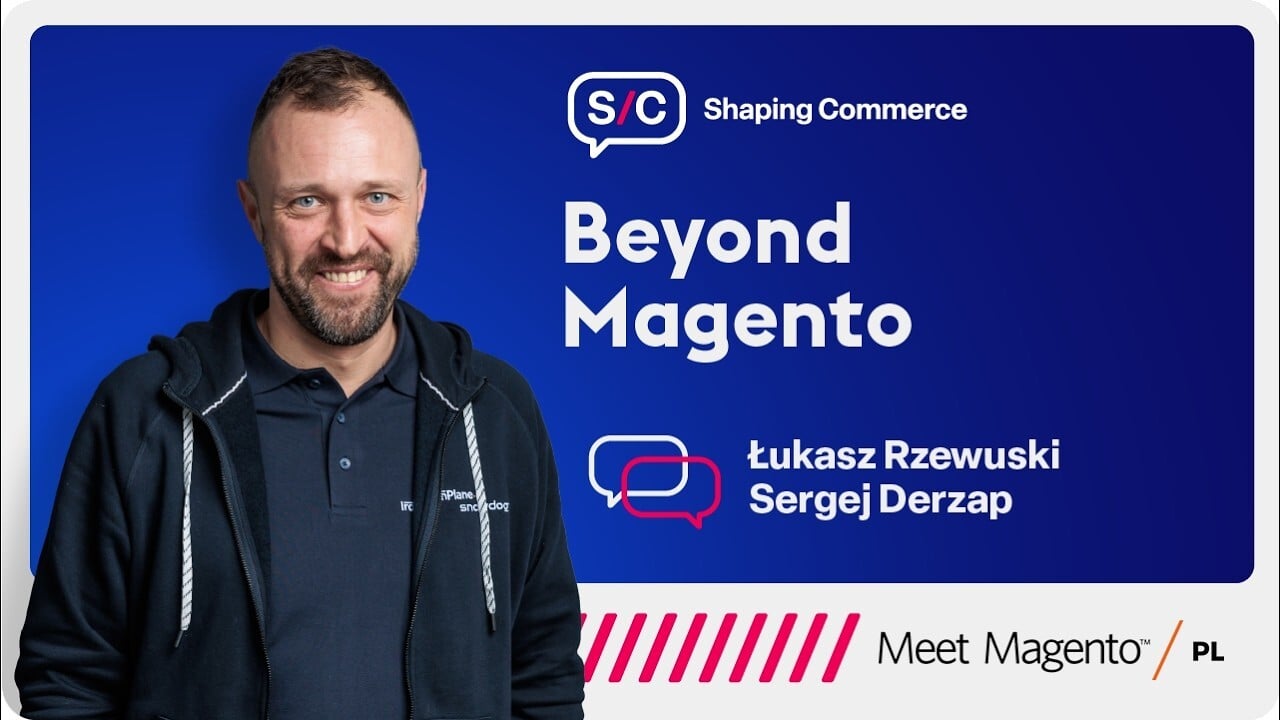
Full transcript of YouTube episode of Shaping Commerce in which we talk with Sergej Derzap from Amasty, who explains how AI is starting to close the e-commerce education gap, making complex platforms accessible to merchants without deep technical knowledge.

Premiered Mar 17, 2026 IronPlane eCommerce Development

"Every second, a Magento store normally uses at least one of Amasty’s extensions. The E-commerce world will be changed. There is no one platform one size that fits all. Next step will be definitely, let's say, search by images."
- Sergej Derzap, CEO of Amasty

Łukasz Rzewuski: Is it a revolution or is it just another tool?

Sergej Derzap:I wouldn't say it's a revolution, but . . . .

[music] [music]

Łukasz Rzewuski: We're joined by Sergej Derzap. Hello, Sergej. Thank you for being here. Sergej is a CEO for Amasty, a leading provider of Magento extensions. You have, what – 100,000 customers at the moment?

Sergej Derzap: It depends how you count. Normally, if we're talking about domain and active domains, I would say that we have more than 25,000 customers worldwide – in terms of domains like active domains – so I would say that penetration rate on the Magento market in the active stores is like every second a Magento store normally uses at least one of Amasty’s extensions.

Łukasz Rzewuski: That's quite a success.

Sergej Derzap: Yes.

Łukasz Rzewuski: You've been dedicated to the Magento world, but for some time you're exploring also other platforms. What is behind this move? Do you want to expand the company or maybe you have doubts about Magento? What's . . . .

Borrowing Shopify's best UX secrets

Sergej Derzap: I would say neither of these two but something else. The case is that the e-commerce world will be changed. Once Shopify appeared, there are – more different options for merchants appeared and there is no one platform, one size that fits all. And what we're trying to achieve is to make sure that regardless what platform a client chooses he can rely on a known brand and we can learn more in this journey.

For example, once we started building extensions for Shopify we tried to adopt the same approach – user friendly approach – for our customers in our Magento products as well. For example, in the Magento way of doing feed, normally you need to configure SFTP feed – but it's pretty complex – while in Shopify, you can make the same in one click just connecting with your Google merchant account.

Łukasz Rzewuski: Mhm.

Sergej Derzap: So, once we understood how it could be implemented in the Shopify world, gathered feedback, and implemented the same in the Magento world – and normally this is what we're trying to do – to enrich our experience from one platform using something outstanding what we see how it fits better merchant experience in another platform. So it's more about building a robust e-commerce experience.

Łukasz Rzewuski: How does it look from behind the curtain? Do your team – are they taking sides – is there a Magento team and a Shopify team and they're competing with each other? Can you share some light on this?

Sergej Derzap: Yeah, taking into account that I’m a certified project manager and I also made lot of agile certification. We decided to use a safe approach.

Łukasz Rzewuski: Mhm.

Sergej Derzap: So it's a scaled agile framework and we are building revenue streams. So normally there are several revenue streams and they are normally independent.

Łukasz Rzewuski: Okay.

Sergej Derzap: So of course there is [inaudible] sharing, of course there is some synchronization, and we have the same cadence in terms of planning. We have one-quarter increments when we are planning our road maps but normally it's completely independent teams that are running each revenue stream.

The golden rule of code & exciting AI roadmap

Łukasz Rzewuski: All right. You come from the tech background, right?

Sergej Derzap: Yeah.

Łukasz Rzewuski: Code is very important for you. What's the one rule you would say your team is not allowed to break when writing the code?

Sergej Derzap: At the moment, what we are trying to achieve is to make sure that our code is reliable. So every release before it goes to production should be accepted by the product team. It gives us a lot of options to control the release itself because there should be someone who is on the side of the merchant before a release goes live.

Łukasz Rzewuski: Yeah.

Sergej Derzap: So there are a lot of checklists but, let's say, when one technical guy decides for himself – it could be, let's say, advocate of the devil – I can agree with myself but here it should be another party who is the advocate of the client.

Łukasz Rzewuski: Yeah.

Sergej Derzap: So normally we are approving all our releases just to make sure that we are maintaining predictable quality and reducing maintenance costs and risks for our clients.

Łukasz Rzewuski: Any news for upcoming many months? Is there something that you will be sharing in predictable time? Do you want to share some light on this?

Sergej Derzap: Yeah, there are several directions that we are working on at the moment, and in the short perspective – I believe in this quarter – we're going to release several new AI related updates. It’s my understanding that at the moment merchants don't want to endanger their revenue streams with implementing AI there, but we can help a lot to automate specific very safe chunks as we already have done first with content AI creation. Now, at the moment, you can create blog post images and, for example, different kinds of content. We implemented then eight for our SEO Toolkit there. So now in the SEO Toolkit bar you can also, let's say, refine some or add some SEO text, for example, in one click if you feel that it's necessary. The next step is going to be implementation of AI into search.

Łukasz Rzewuski: Mhm.

Sergej Derzap: When we will try to help search to be smarter. For example, you have an English-based – English speaking – database. But someone from the Polish market comes to your store and tries to find navigation in Polish.

Łukasz Rzewuski: Yeah.

Sergej Derzap: Normally, what Magento extension will return to you?

Łukasz Rzewuski: Nothing.

Sergej Derzap: Nothing. But here we can involve AI and ask for the synonym in the required language and then you get synonyms like in English and you can show the results.

Łukasz Rzewuski: Absolutely.

Sergej Derzap: And then if it works add it into, let's say, the Elasticsearch engine and next time it's going to happen automatically. So you are enriching your vocabulary of synonyms and you don't need to make it manually every time looking at what's happening with your “no found” issues – and it's from one side. From the other side, you don't need to spend tons of money for very heavy products that probably your store is not looking for at the moment, let's say, services. You're probably for open source concept, so it's a tradeoff when you are using the force of AI but making it smarter.

The next step will definitely be search by images that we're also going to add to our search engine and many, many, many more related to Hyvä Commerce. So we already have Blog integrated with Hyvä Commerce and many more extensions are also in a road map to add Hyvä the same as, for example, there.

Łukasz Rzewuski: Better things are coming.

Sergej Derzap: Yeah, for sure. We’re always looking for the feedback from our customers. We see how adoption goes, and in the directions where we see more adoption, we are prioritizing. For example, the main point until today was CSP that was introduced recently this year and it should be basic compliance for every European store or store that would like to be compliant with payment systems. And another thing is accessibility for Europe that we worked with Snowdog together to make fully accessible – shops we made fully accessible. B2B Suite we improved a lot – B2B to make sure that you can switch from Adobe Commerce to Magento Open Source without lacking the functionality for the B2B store. Yeah, and we see good results here.

How AI is revolutionizing customer support

Łukasz Rzewuski: Great, great hearing this. And we've touched on AI regarding end users. How has AI changed your day-to-day activities in the company? How has it affected the speed of writing code? Is it a revolution or is it just another tool that tweaks doing things a bit? But what's your take on this?

Sergej Derzap: I wouldn't say it's a revolution, but it helps in specific – we're trying and experimenting with it in different directions. For example, we have our customer support project that helps us to automate specific responses. Normally it's like structuring data, making sure that nothing is missing and there's very clear guidance on the solution how client should implement it. So at the moment some of our clients can receive the update from Amasty that comes almost instantly with an already prepared solution for them and that has a note below that the solution is generated by AI.

Łukasz Rzewuski: Okay.

Sergej Derzap: And we're experimenting with it and so far we received only positive feedback from the customers saying yeah it definitely helped. We like that you implemented it into your process because now we can get help faster without the impact of the quality – because we are checking every such response and the feedback to make sure it definitely helps and customers can benefit from it. Because regardless of what SLA you have, a human is not able to process information to provide answers so fast. Take into account that we worked for a long time implementing a knowledge base – different conflict databases that you can use to resolve the conflict with another extension provider for their specific product. Now we can feed this information into our AI system and generate specific answers way faster and I believe it's just the beginning of the story. We would like to make it even better for our customers. First they will try it in support, but later I believe a lot of customers will feel that they can in a human language configure their products, for example.

Łukasz Rzewuski: Yeah, that's an amazing vision. I'm looking forward to it and it will bridge the gap that there are people with amazing ideas who don't know how to code but with the help of AI translating natural language to the code it will be the next big thing, I believe.

Lowering the barrier: Can AI make Magento easy?

Sergej Derzap: It will make, let's say, necessary knowledge about Magento minimal.

Łukasz Rzewuski: Yeah.

Sergej Derzap: And you still can use the advantages of Magento because at the moment it is the most powerful system I ever heard about in the e-commerce world. But the main problem is that there is an educational gap / entrance gap that you need to cover and normally you need more education than to run a sales business, right? But moving forward, we believe we can decrease this gap and make it so minimal so you can just talk as with AI chatbot and receive your store compatible. In terms of development, it's not so easy to implement it, but we see there is definitely a good value when you're fixing something or, for example, you are checking security issues, you can explain the pattern and check your codebase if there are any issues with it.

Łukasz Rzewuski: Sergej, I feel like we could talk for hours. It's been amazing having you here. Happy to dive deeper next time. Thank you, have a great conference, and let's talk again later.

Sergej Derzap: Well, thank you for inviting me.

Łukasz Rzewuski: Thank you. Thank you very much.

Read more related blogs

The Evolution of E-Commerce (Part 1)

The Evolution of E-Commerce (Part 1)

Is open source still the king of e-commerce or is the AI-driven revolution changing the game for everyone? Part 1 of our deep dive into the state of the industry in 2026.

Read More
eCommerce Platform Pricing: Adobe Commerce Cloud & Magento Open Source

eCommerce Platform Pricing: Adobe Commerce Cloud & Magento Open Source

Find an eCommerce solution that fits both your needs and budget with this guide comparing the pricing of Magento Open Source and Adobe Commerce.
Read More
Hyvä for Magento: A Clear Guide to the Theme, Checkout, Commerce, and Frontend Ecosystem

Hyvä for Magento: A Clear Guide to the Theme, Checkout, Commerce, and Frontend Ecosystem

A clear guide to the Hyvä ecosystem for Magento. Learn how Hyvä Theme, Checkout, and Commerce work, and what merchants gain from migrating to Hyvä.

Read More